


Activists from the Anti-Poverty Alliance, which comprises 13 civic groups, held a press conference at the legislature in Taipei yesterday urging legislators to address the problem of the widening disparity between rich and poor in Taiwan.
They also announced plans for two 44-hour hunger strikes that will begin on Sunday.
Anti-Poverty Alliance representative Chien Hsi-chieh , a former Democratic Progressive Party lawmaker, said the gap between rich and poor is expanding in Taiwan, just like in the US and Europe.
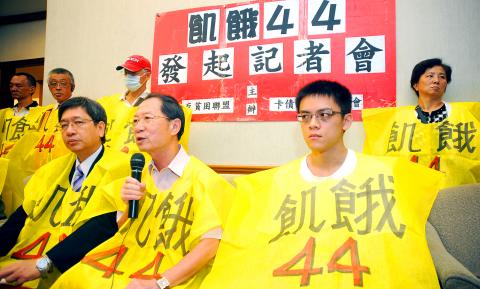
Photo: Liu Hsin-de, Taipei Times
Taiwan’s economic growth rate last year was 10.8 percent and labor productivity increased by 16 percent, but wages decreased by 11 percent, the alliance said.
It said the total income of employees accounted for only 44 percent of GDP, which was lower than in many other countries.
Twenty-five people from Taiwan were listed on Forbes’ latest list of the world’s richest people, and the wealth of the top 10 richest people in the nation has increased from US$30 billion to US$40.7 billion, Chien said.
However, there are about 1.04 million workers in Taiwan who receive less than NT$20,000 per month, he added.
He also questioned why the government gave preferential treatment, such as a sales tax exemption, to banks but not to other sectors, and said mounting frustration over the plight of the average wage earner would express itself as it had in recent weeks on Wall Street.
“Occupy Wall Street is not a single incident, but is spreading around the world,” Chien said.
Chien said the alliance would hold two “44-Hour Famine” hunger strikes to raise awareness about the unfair distribution of wealth in the country, with workers not receiving their deserved share.
The hunger strikes will take place in front of the legislature. The first will run from Sunday to Tuesday and the second will run from Tuesday to Thursday.
The groups will also protest against the government giving tax relief to enterprises when the working poor are becoming poorer, and they want to experience poverty through fasting.
Chen Fang-yu (陳方隅), a representative from a group called “Young people want to be rich,” said that about one-fourth of young people in their 20s work as dispatch workers or as hourly wage workers, often with low incomes, long working hours and no welfare benefits.
He said with incomes so low and housing prices high, “who still wants to get married and have children?”
Lin Yung-sung (林永頌), an attorney who advises victims of credit card debt, said some workers are only paid about NT$20,000 per month and had to pay between NT$4,000 and NT$5,000 per month to labor dispatch agencies.
Lin said that as many as 1.04 million Taiwanese — or 15 percent of the working population — earn less than NT$20,000 a month.
That means there are 220,000 more people in that income group than in 2008, at the height of the global financial crisis, Lin said.
The alliance said unemployment and low incomes were the roots of poverty and called on legislators to amend the Statute For Consumer Debt Clearance (消費者債務清理條例), regulations on student loans and the Housing Act (住宅法) during the current legislative session.
The alliance also voiced support for the “Occupy Taipei” rally that is scheduled for Saturday outside Taipei 101.
Additional reporting by CNA

UPGRADE: The Kang Ding-class frigate is replacing its Chaparall missiles with Tien Chien II and Hua Yang VLS, which would provide it with long-range, 360° air defense Taiwan plans to produce 1,200 to 1,376 Hai Chien II missiles (海劍二, Sea Sword II) — also known as TC-2N — to serve as the standard air defense system of the navy’s surface combatant fleet, a source said yesterday. Last week, the Hai Chien II, the naval version of the Tien Kung II missile (天劍二, Sky Sword II), completed a live-fire test in waters off the National Chungshan Institute of Science and Technology’s Jiupeng facility (九鵬) in Pingtung County’s Manjhou Township (滿州). The MIM72 Chaparral and other dated air defense missiles that currently arm Taiwanese ships have inadequate range to combat Chinese

REASONS FOR TRAVEL: An assistant professor said that proposed amendments to penalize drivers if they used drugs overseas would not deter people from traveling People who operate a motor vehicle under the influence of marijuana would have their driver’s license revoked, even if they used the substance while overseas, the Ministry of Transportation and Communications said yesterday, citing proposed amendments to the Road Traffic Management and Penalty Act (道路交通管理處罰條例). The amendments would also authorize the government to revoke the licenses of people determined to have used Category 1 or Category 2 narcotics, even if they were not operating a vehicle while under the influence of drugs, as well as ban them from taking the license test for three years, the ministry said. People aged 18 or

HEAVY WEATHER: Typhoon Jangmi is due to crash straight into the Ryukyus as airlines look to shift flights to larger aircraft or cancel flights to Okinawa entirely Taiwan’s international air carriers announced flight adjustments over the weekend as Typhoon Jangmi is forecast to hit the Ryukyu Islands today and tomorrow. The Central Weather Administration (CWA) upgraded Jangmi from a tropical storm to a typhoon at 8am yesterday, with the eye located 580km south of Naha city. It was moving north at 19kph. Today, China Airlines’ CI-120, CI-121, CI-122 and CI-123 flights between Taoyuan and Naha, Okinawa, have been canceled as well as CI-132 and CI-133 between Kaohsiung and Naha. EVA Air’s BR-112, BR-113, BR-186 and BR-185 flights between Taoyuan and Naha are also canceled. Low-cost carrier Tigerair Taiwan canceled IT-230,
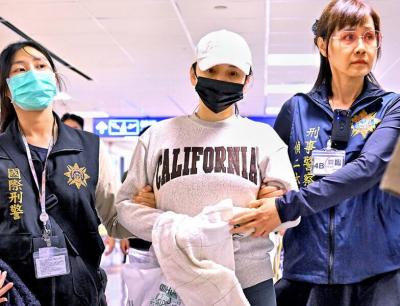
Johanne Liou (劉喬安), a Taiwanese woman who shot to unwanted fame during the Sunflower movement protests in 2014, returned to Taiwan last night after being deported from the US. She is to stand trial in Taiwan for charges involving embezzlement, fraud and drug crimes. The Criminal Investigation Bureau (CIB) said it took her into custody at Taiwan Taoyuan International Airport and would first question her before transferring her to the New Taipei District Prosecutors’ Office. She was arrested upon disembarking a flight from San Francisco that landed shortly before 7pm. Liou absconded to the US in 2019 after jumping bail


 RSS
RSS